
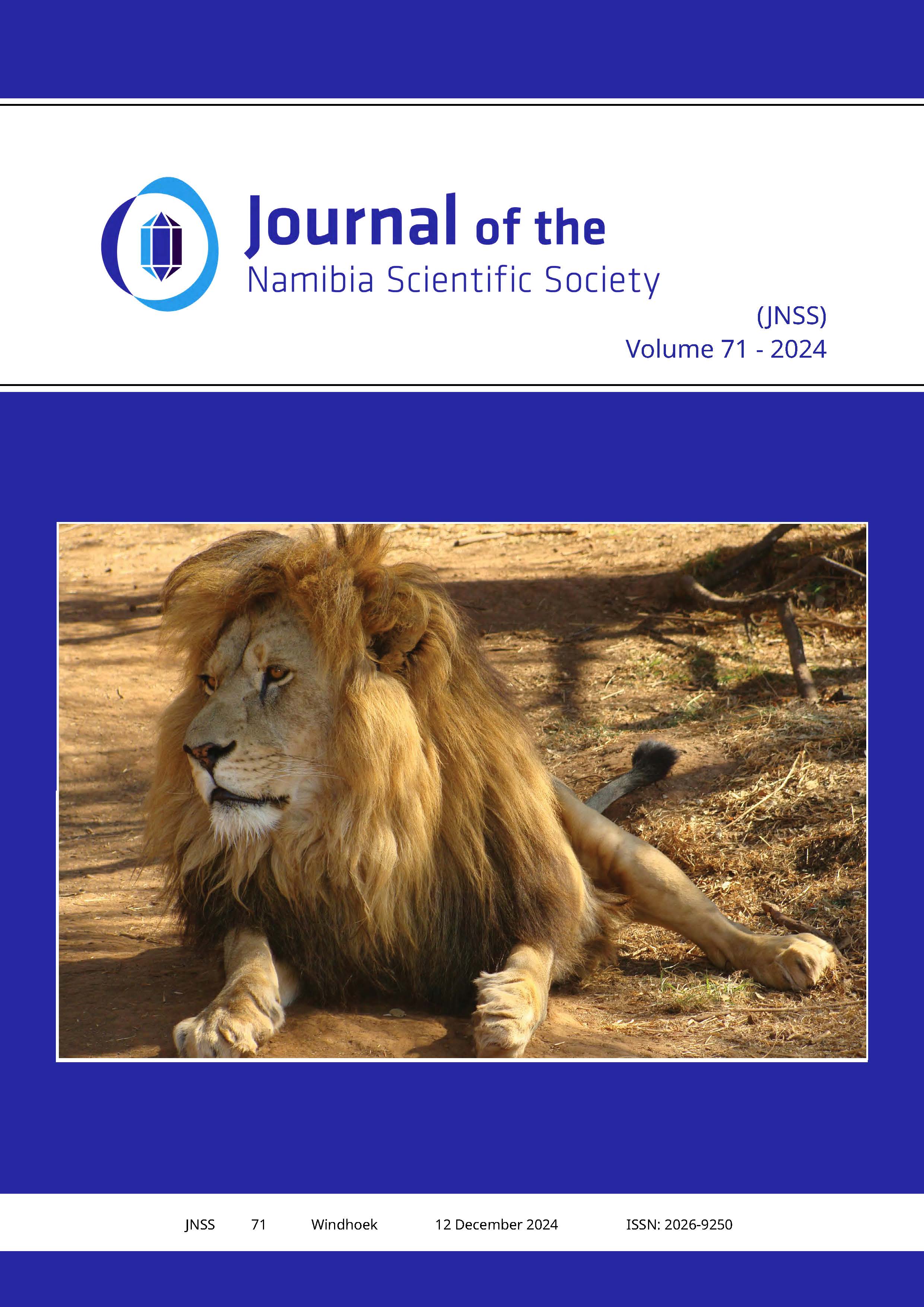
Assessing the health of lions (Panthera leo) in a reserve
Astudy of Body Condition Score and Stomach Contents Index
DOI:
https://doi.org/10.66365/jnss.2024.07Keywords:
Body condition score, Stomach contents index, Animal health, Camera trap, Panthera leo, lion, reserve management, NaankuseAbstract
This research assesses the potential of the body condition score (BCS) and the stomach contents index (SCI) as indicators for monitoring the health status of lions within a fenced-off reserve in central Namibia. BCS is a non-invasive management tool that evaluates an animal’s accumulation of fat and muscle, and SCI is the measure reflecting the saturation state of the stomach. Using 3,700 camera trap pictures from November 2018 to August 2023, we firstly study BCS and SCI of five adult lions (Panthera leo), including two males and three females in a 7,500 hectare fenced-off reserve. Then, we investigate the potential correlation between BCS and SCI and analyse whether factors such as sex, moon phase, season, and time of day have an impact on BCS and SCI. Finally, we investigate the influence of BCS and SCI on the drinking behaviour of the lions. We found that BCS assessments reveal an ideal health status among the lion population in this reserve, while SCI demonstrates a rapid and dynamic response to their feeding behaviour. Analysing the five lions simultaneously reveals a significant positive correlation between BCS and SCI. Concerning the males and females, BCS remains stable across sex but differs between long-term residents and newly introduced lions. In contrast, SCI is unaffected by sex or lion introductions. Our study found no significant variations in BCS and SCI according to the moon phases. While no significant difference in BCS distribution was observed across seasons, SCI varied between dry seasons (dry summer and dry winter) and humid seasons. BCS and SCI showed no differences during dawn, day, and dusk, but we found differences for both between night on the one hand and dawn, dusk, and day on the other. Both BCS and SCI influence their drinking behaviour. The conclusion is that understanding BCS and SCI enhances the monitoring of lion health status, enabling action to be taken accordingly for the effective management of a fenced-off reserve.
Downloads
Published
Issue
Section
License
Copyright (c) 2026 Matthieu Müller, Tanja Baetcke-Vilho, Rudie van Vuuren, Marlice van Vuuren (Author)

This work is licensed under a Creative Commons Attribution 4.0 International License.
Articles published in the Journal of the Namibia Scientific Society are licensed under a Creative Commons Attribution 4.0 International License (CC BY 4.0).
This license allows users to copy, distribute, and adapt the material for any purpose, including commercial use, provided that appropriate credit is given to the original author(s) and the source, a link to the license is provided, and any changes made are indicated.
Authors retain copyright of their work and grant the journal the right of first publication.
All users must ensure proper attribution when reusing or citing published material.